Oct 6, 2026Blog
Smartwatch GPS Guide: Single-Band vs Dual-Band L1+L5 Positioning
Dual-band GPS (L1+L5) improves position accuracy from 5–10m to 1–3m in urban canyons and under tree cover — here is how dual-frequency positioning works.
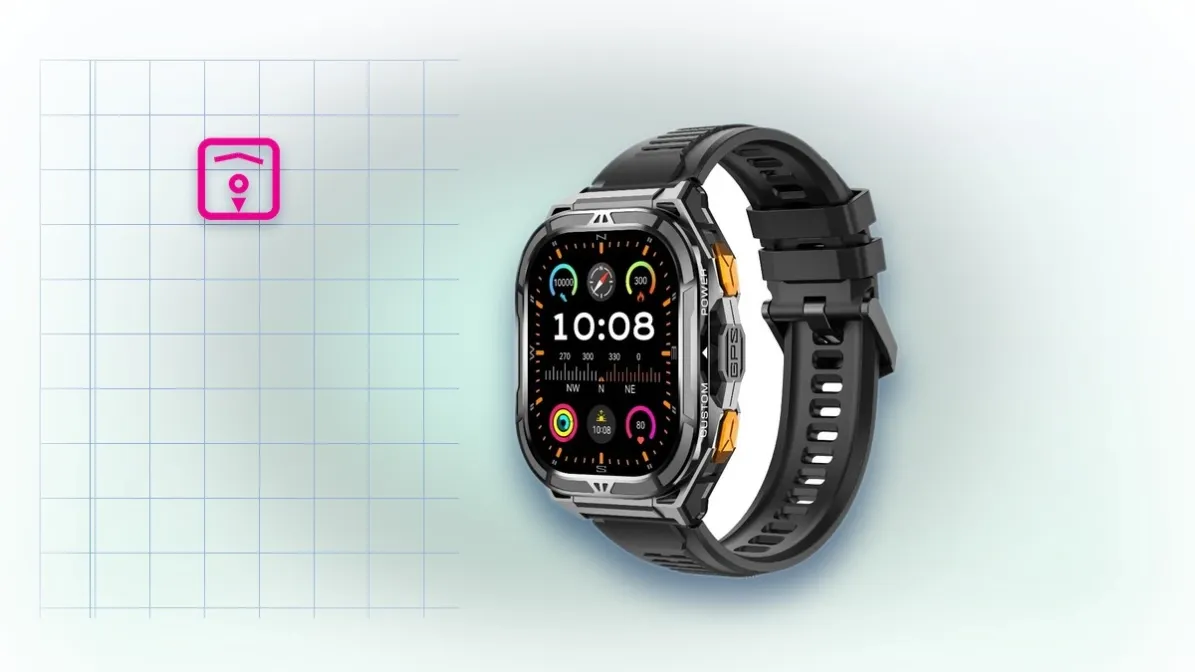
GPS accuracy in a smartwatch depends on how many frequency bands the receiver can use. Single-band GPS (L1 only) struggles in cities with tall buildings and under tree cover. Dual-band GPS (L1+L5) uses two frequencies to reject reflected signals — improving position accuracy from 5–10m to 1–3m in challenging environments.
How GPS Works in a Smartwatch
The GPS receiver listens for signals from positioning satellites (GPS, GLONASS, Galileo, BeiDou). Each satellite broadcasts its position and a timestamp; the receiver calculates distance from the signal travel time and triangulates position.
The problem: satellite signals bounce off buildings, walls and terrain before reaching the receiver. These multi-path reflections confuse the position calculation, producing the "GPS drift" you see when running through a city.
Single-Band vs Dual-Band
Single-band receivers listen on the L1 frequency (1575.42 MHz). This is the original GPS signal — reliable in open sky, but vulnerable to multi-path reflection in urban canyons and under tree canopy.
Dual-band receivers add the L5 frequency (1176.45 MHz). L5 signals are broadcast at higher power and with a wider bandwidth, making them more resistant to reflection. By comparing L1 and L5 measurements, the receiver can identify and reject multi-path signals.
The result: 1–3m position accuracy in urban environments (vs 5–10m for single-band), faster satellite lock, and more consistent pace/distance tracking under tree cover.
What This Means for Runners and Cyclists
If you run or cycle in a city, dual-band GPS produces pace and distance data you can actually trust. The difference is visible on the route map: single-band tracks zigzag around the true path; dual-band tracks stay on the road.
For trail runners under tree canopy, dual-band maintains satellite lock where single-band devices lose signal entirely.
For OEM Buyers
The GPS smartwatch collection on this site includes dual-band L1+L5 models with offline maps and route-back navigation. Confirm the GPS chipset (single vs dual-band), satellite system support and offline map coverage at the sampling stage — trial orders from 100 pcs are negotiable case by case.
FAQ
Is dual-band GPS worth it? For city runners and trails, yes — accuracy improves visibly.
Which satellite systems? GPS, GLONASS, Galileo, BeiDou — global coverage.
FAQ
Is dual-band GPS worth the extra cost? For city runners and trail users, yes — the accuracy improvement is visible on every route map.
Which satellite systems are supported? GPS, GLONASS, Galileo and BeiDou — global coverage without regional limitation.
Key Specifications
Spec | Detail |
|---|---|
GPS chipset | Dual-band L1+L5 |
Accuracy (open sky) | 1–3 m |
Accuracy (urban) | 1–3 m (vs 5–10 m single-band) |
Satellite systems | GPS · GLONASS · Galileo · BeiDou |
Offline maps | Route-back navigation |