Oct 6, 2026Blog
Smart Ring for Sleep Tracking: Why the Finger Beats the Wrist
Finger arteries are closer to the skin surface than wrist arteries — smart rings produce cleaner PPG signals and more accurate sleep staging than wrist devices.
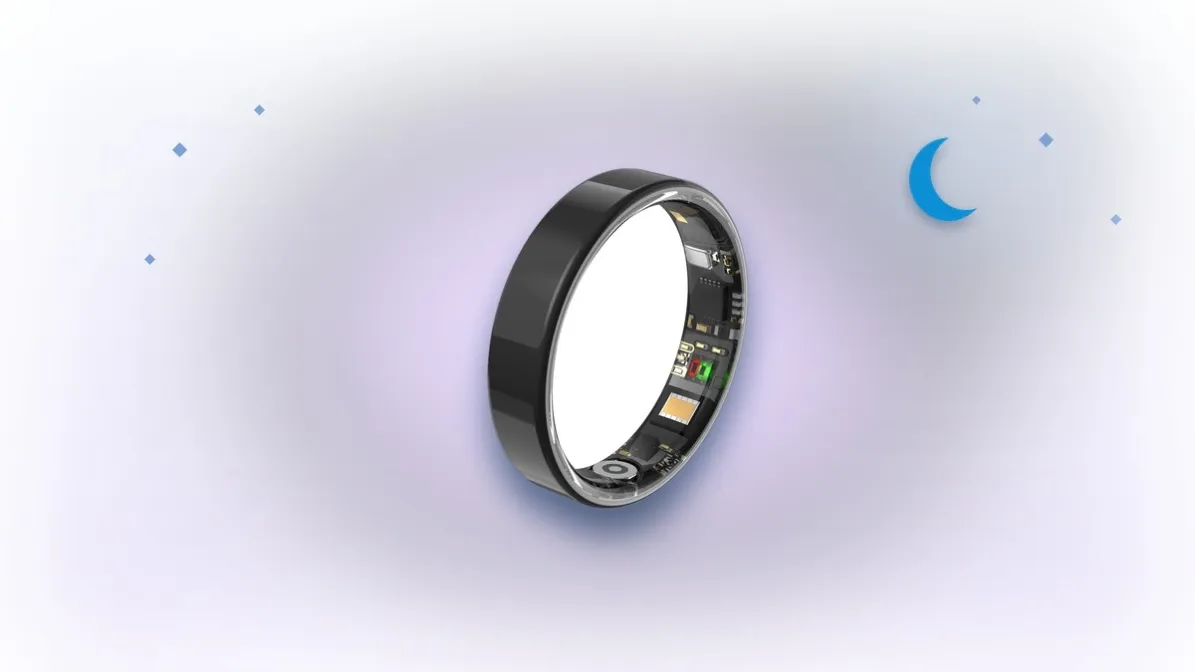
Sleep tracking is the number-one use case for smart rings — and the finger is objectively a better measurement site than the wrist for the sensors that make sleep tracking possible. Here is the physiology, and what it means for the data.
Why the Finger Beats the Wrist for PPG
PPG (photoplethysmography) works by shining light into the skin and reading the reflected pulse. The quality of the signal depends on how close the arteries are to the surface and how stable the sensor is against the skin.
The finger has distinct advantages: the digital arteries are closer to the surface than the radial arteries at the wrist, the finger has fewer tendons and bones between the sensor and the blood flow, and a ring form factor naturally maintains constant contact — it cannot slide around the wrist during sleep the way a band does.
The result is a cleaner PPG waveform with fewer motion artefacts, which produces more reliable sleep staging, heart rate and HRV data.
What the Ring Measures During Sleep
A well-fitted smart ring with a full sensor stack captures:
- Sleep stages — light, deep and REM, inferred from HRV, pulse rate and motion
- Sleep timing — bedtime, wake time, latency and efficiency
- Night-time heart rate — resting HR trend across the night
- SpO2 — blood-oxygen saturation, including dips
- Breathing rate — respirations per minute during sleep
- Skin temperature — baseline variation for illness and cycle tracking
The data syncs to the companion app on waking, producing a nightly sleep report with a quality score.
Ring vs Band vs Watch for Sleep
Factor | Ring | Band | Watch |
|---|---|---|---|
Weight (typical) | 3–5 g | 19–25 g | 35–50 g |
Night comfort | High | Medium | Low-Medium |
PPG signal quality | High | Medium | Medium |
Battery (nights without charge) | 5–7 | 10–20 | 3–7 |
Charging breaks data | Every 5–7 nights | Every 10–20 nights | Every 3–7 nights |
The ring wins on signal quality and comfort; the band wins on battery runtime between charges.
For Brands: Sleep Is the Lead Message
Sleep tracking is the number-one consumer use case for smart rings — it is the easiest benefit to demonstrate and the most likely to drive daily engagement. Confirm the sleep staging algorithm, the app's sleep report format and the validation data (vs polysomnography) at the sampling stage. The ECG smart ring on this site includes the full sleep and health sensor set.
FAQ
Is a ring accurate for sleep tracking? The finger provides a cleaner PPG signal than the wrist — published validation studies show correlation with polysomnography.
Does the ring need to be removed for charging? Yes — every 5–7 nights. The charging dock takes 60–90 minutes.
Can it detect sleep apnoea? SpO2 dips and breathing-rate changes are screening indicators — not a medical diagnosis.
Key Specifications
Spec | Detail |
|---|---|
Sleep stages | Light, deep, REM |
SpO2 | Night-time oxygen |
HRV | Beat-to-beat variability |
Temperature | Baseline variation |
Battery | 5–7 nights continuous |