Oct 6, 2026Blog
Screenless Band vs Smartwatch: Which Wearable Fits Your Routine?
Screenless band or smartwatch? Compare battery, comfort, health data and price across the two wearable styles to pick the right one for your routine.
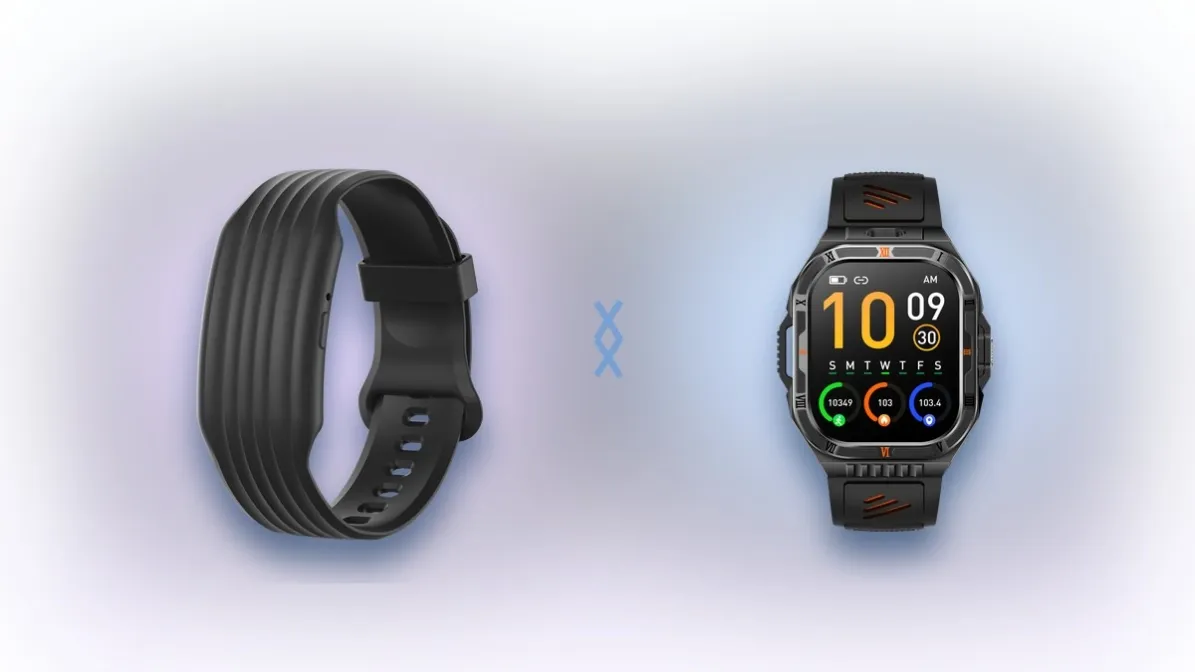
Screenless band or smartwatch — both track your steps, heart rate and sleep, but they answer two different questions. A smartwatch puts information on your wrist; a screenless band removes the wrist screen entirely and hands everything to your phone. Picking the right one is about matching the design to how you actually live.
This comparison walks through the five differences that matter — battery, comfort, health data, distraction and price — so you can decide in five minutes which style fits your routine.
Battery Life: Weeks vs Days
The display is the single biggest power consumer in any wearable. Remove it, and the same battery stretches dramatically further.
A screenless band with a 200 mAh cell runs 10–20 days of tracked use and 30+ days on standby. A full smartwatch with an AMOLED panel typically needs charging every 3–7 days — and sleep tracking breaks every charging night.
If you are evaluating the category for sleep data specifically, this is the deciding row of the comparison: an unbroken data series requires a device that does not come off every night.
Comfort: 19 Grams vs a Watch Case
A screenless band with a woven strap weighs about 19 grams and has no glass face pressing into the wrist. It disappears during sleep, showers (3ATM splash rating) and typing.
A smartwatch carries a metal or plastic case, a glass cover and a heavier strap — typically 35–50 g. Some wrists adapt; others never do.
Health Data: Closer Than You Think
Modern screenless bands carry a serious sensor stack: continuous heart rate, blood pressure trends, SpO2, sleep staging, HRV, stress and women's health tracking — plus 110+ sports modes on the reference platform. An ECG variant adds single-lead electrocardiogram with SOS calling.
The smartwatch shows the same metrics on the wrist, plus GPS mapping and third-party apps. If on-wrist GPS navigation is your use case, the watch wins. If daily health data is the goal, the band covers it.
Distraction: Feature or Compromise
The band never buzzes with messages, never lights up mid-meeting, never invites you to check something. For users who find this liberating, it is the main reason to choose screenless. For users who rely on wrist notifications, it is the main reason not to.
Price: The Entry Point
Removing the display removes its cost. A screenless band delivers the health-data layer at a materially lower price than a smartwatch — which is why brands use it as the entry SKU of a wearable line, with the watch as the upsell.
The Decision in Three Questions
- Do you need information on your wrist during the day — or is the phone enough?
- Does weekly charging break your routine — or your sleep data?
- Is your priority health data and comfort — or apps and maps?
Two or more answers pointing to "no screen needed" and the screenless band is your category. It pairs a 200 mAh battery, 10–20 day runtime and the full health set — HR, BP, SpO2, sleep, HRV, stress — in a 19.3 g woven build with the Flywear app.
Brands: many carry both styles, with the band as the entry SKU and the watch as the upgrade — the screen-free ECG band bridges the two for health-first positioning.
FAQ
Does a screenless band track workouts without a display? Yes — 110+ modes with 6 auto-recognized; sessions appear in the app after sync.
Which is better for sleep tracking? The band: lighter, no screen to wake you, and the battery lasts through weeks of nights.
Can a screenless band show notifications? No — that is the trade. The band records; the phone displays.
Match the Style to Your Week
A simple way to decide: map your typical week against the two designs.
Your week | Better fit | Why |
|---|---|---|
Desk work, evening runs, sleep focus | Screenless band | No distractions, weeks of sleep data |
Travel, outdoor navigation, calls on the move | Smartwatch | GPS, maps and calls on the wrist |
Training block with recovery tracking | Screenless band | Unbroken HRV and sleep series |
Triathlon or trail racing | Smartwatch | On-wrist pacing and navigation |
Gift for a health-conscious parent | Screenless band | Simple, light, weeks-long battery |
Most routines land clearly on one side. If yours is mixed, the screenless band as an always-on health layer plus a watch for specific activities is a common combination — many users wear the band to bed and the watch only for workouts.