Oct 6, 2026Blog
Fitness Tracker Battery Life: How Screenless Bands Hit 10–20 Days
Why do screenless fitness bands last 10–20 days on a 200 mAh battery while smartwatches need weekly charging? The engineering, explained simply.
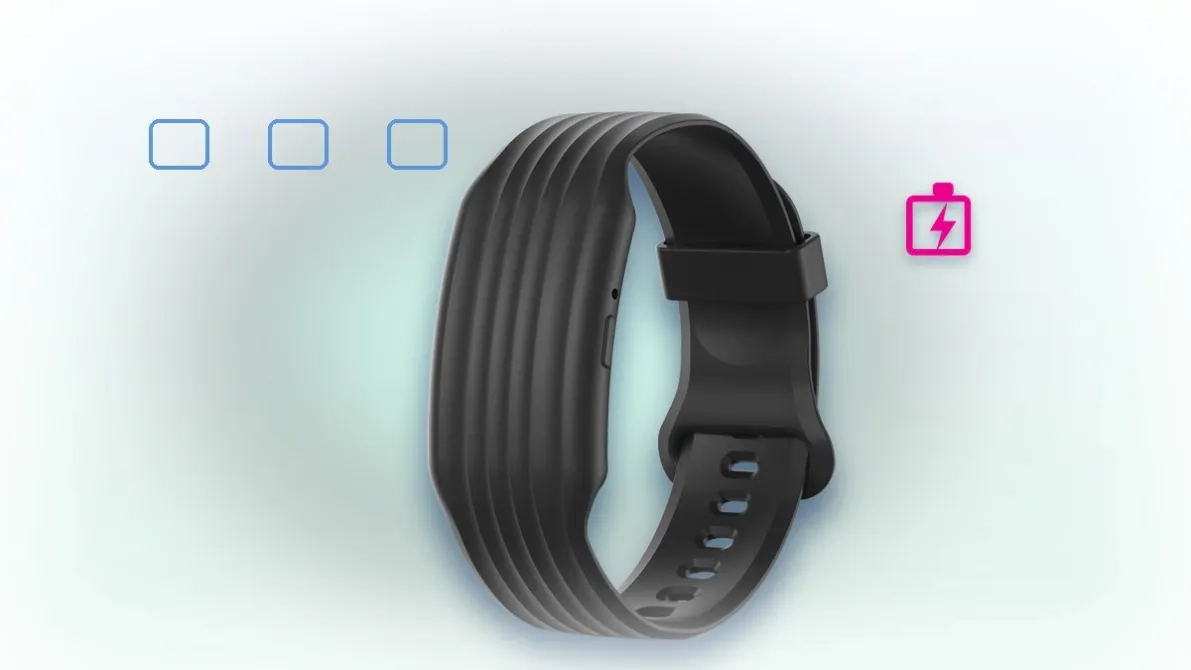
Battery life is the number-one complaint about wearables — and the number-one surprise about screenless bands: a 200 mAh battery that runs 10–20 days per charge, with 30+ days of standby. No nightly charging, no dead band by dinner. Here is the engineering behind the number, and what it means in practice.
Where the Weeks Come From: No Display, No Drain
The display is the single biggest power consumer in any wearable. A color touch panel draws more current than the sensor stack, the Bluetooth radio and the processor combined.
Remove the panel and the power budget transforms: the same 200 mAh cell that powers a screen-heavy smartwatch for 3–7 days stretches to 10–20 days of continuous tracking in a screenless band. The math is not marketing — it is the absence of the component that dominated the old budget.
Low-Power Silicon Does the Rest
Screenless bands run Bluetooth SoCs designed for months of duty on coin cells — BLE 5.3 in the reference platform — spending most of their life in sleep and waking for sensor samples, syncs and button presses.
Sensor duty-cycling extends the budget further: heart rate is sampled in intervals rather than measured continuously, and the accelerometer wakes only on movement. Each design decision trades a little resolution for days of runtime — a trade sleep-tracking users are happy to make.
What 10–20 Days Means in Practice
Three practical wins follow from the number:
- Unbroken sleep data. The band stays on all night because it does not need to come off for charging — sleep staging, SpO2 and night-time HR continue without gaps.
- Travel without cables. A week-long trip needs no charger at all.
- Monthly rhythm. Charging becomes a twice-a-month habit rather than a nightly one — the habit-drop rate of the category is a fraction of screen-first wearables.
30+ days of standby covers the drawer scenario: the band works after weeks in a bag.
Charging: 90 Minutes Twice a Month
When the battery does need a top-up, the magnetic clip charges the cell in about 90 minutes. There is no wireless pad to align and no cable to lose — the clip attaches directly to the band.
For Brands: The Battery Claim You Can Defend
Battery life is the easiest wearable claim to test and the easiest to defend — which makes it a strong lead message for a screenless band line. Confirm the test protocol (continuous HR, notifications on, brightness n/a) at the sampling stage; the reference screenless band documents 200 mAh, 10–20 days and 30+ standby as standard specifications.
Trial orders from 100 pcs are negotiable case by case — and the battery claim ships in the product copy, validated before production.
FAQ
Does turning off heart rate extend the battery? Yes, but the band is designed to run full tracking within the 10–20 day budget — no need to disable features.
How is 3ATM different from swim-proof? 3ATM covers splashes, sweat and rain — not swimming. Check the model page for immersion guidance.
Does the battery degrade? Like all lithium cells, capacity fades over cycles; monthly charging means far fewer cycles than nightly-charged devices.
The Numbers at a Glance
Style | Battery | Tracked use | Standby | Charging |
|---|---|---|---|---|
Screenless band (200 mAh) | 200 mAh | 10–20 days | 30+ days | Twice a month, 90 min |
Typical smartwatch (AMOLED) | 300–500 mAh | 3–7 days | — | Every 2–3 nights |
Typical smartwatch (power save) | 300–500 mAh | 7–14 days | — | Weekly |
The screenless row is not a marketing claim — it is the direct consequence of removing the component that dominated the power budget. For brands, the same table is the strongest page-one claim a screenless product can make: specific, testable and impossible for a screen-first competitor to match.