Oct 6, 2026Blog
How to Evaluate an OEM Supplier's Ready Platforms
A five-dimension pre-sampling checklist, demonstrated on a real catalog.
If your supplier shortlist is done and a sample order is next, the question of how to evaluate OEM supplier products arrives after the catalogs are already open and every page looks like every other page. The direct answer: hold each candidate up to five dimensions before you commit — catalog structure, specification verifiability, configuration variants, sample process, and communication — pick one or two platforms per supplier, and only then transfer sample money. Run the five-dimension checklist first, and spend sample money second. The checklist is deliberately supplier-neutral: it works on any catalog, and the one on this site is used below only as the worked example. If you are picking a smartwatch or a pair of smart glasses for personal use, this page is not for you. This page is a demonstration draft prepared for site review and is an illustrative example, not real published content.
Dozens of similar models, one sample budget
- You are a brand owner, DTC operator, marketplace seller, or regional distributor who has already shortlisted candidate suppliers for a private-label wearable program.
- The trigger is the next step: one or two platforms have to be picked out of each catalog to carry a sample order.
- The evidence gap is that every catalog lists dozens of similar-looking models — similar silhouettes, similar feature words — and nothing in the page order tells you which platform actually matches the market you are entering.
- The rework is the wrong pick itself: a platform chosen on impressions, sampled, then set aside when it misses your requirement sheet.
- The consequence is a sample budget spent proving a model was never right, and a launch pushed back by a full sample cycle.
- The decision is to run a structured evaluation over each candidate platform first, and move sample money only after the checklist is done.
A model chosen without a checklist costs the same sample fee and returns the least.
The five dimensions to check before you commit
Three dimensions you can run in an evening, from the catalog itself; the last two by sending the same message to every candidate and comparing what returns. The table below is the checklist in compact form; the next section works the first three against a live catalog.
Dimension | What you examine | What a strong signal looks like |
|---|---|---|
1. Catalog structure | Whether models form configuration tiers or fill a page count | Groups that map to use cases — sports, outdoor, thin, health |
2. Specification verifiability | Whether page declarations are specific enough to paste into a requirement sheet | Named values and named features, declared per model |
3. Configuration variants | Whether one series shows real tier differences between adjacent models | A series that steps up in declared configurations |
4. Sample process | How the path from question to sample is structured | Answers that arrive in sequence: model, configuration, sample scope |
5. Communication | Whether the reply answers the configuration you actually asked about | A response that quotes your requirement lines back to you |
The five dimensions are checks you run on any supplier; no catalog owns them and no catalog is exempt from them.
Dimensions one to three on a live catalog
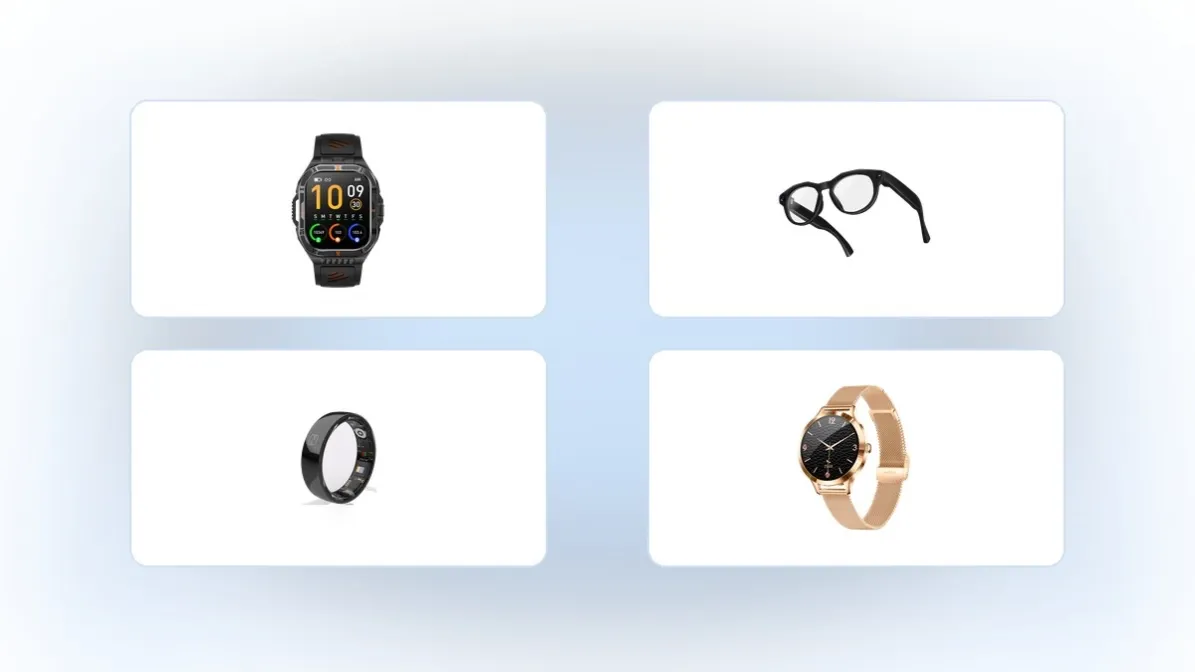
The worked example below is the the catalog on this site — 41 products across 20 smart watches, a fitness tracker, 18 smart glasses, and two smart rings — chosen because it is the example at hand, not because the method favors it. Walk the three checks through it once, then repeat them on any supplier's pages and reach a verdict the same evening.
Dimension 1: catalog structure — tiers or filler?
Ask first whether the catalog is organized the way a supplier who designs to problems would organize it. The 20 smart watch models on this site read in four rough tiers: sports models built around GPS positioning, rugged outdoor models, ultra-thin models in a slimmer business direction, and health-monitoring models. The 18 smart glasses split into three declared groups — Audio Glasses with four models, AI Smart Glasses with twelve, and Waveguide Smart Glasses with two. The two smart rings form two levels of their own: the smart ring R1 page lists a slim health-tracking design, while the V8 page lists an ECG smart ring. A catalog grouped by use case is evidence the supplier knows which problem each model solves; a wall of near-identical models is evidence of the opposite. When you open another supplier's catalog, count the tiers before you count the models.
Dimension 2: specification verifiability — can the page text become a requirement line?
The test is mechanical: take a declaration off a product page and ask whether it can be pasted into your requirement sheet without becoming vaguer. The pages on this site pass it the way you want to see elsewhere. The SW-X2 page lists 3ATM and IP69K protection together with dual-band L1+L5 positioning — lines a buyer can quote. The SW-HT36 page lists a rugged outdoor build with a rotating crown and Bluetooth calling. The SW-KC102 page lists ECG, HRV, and body temperature monitoring alongside SOS. Specific declarations do two jobs at once: they become your requirement lines, and the lines a quotation has to answer. Pages that stay at the level of a "great battery" and a "fashion design" can do neither. One boundary keeps this page in its lane: catalog materials may also declare factory test items such as button life and waterproof checks, and how to read those claims is the subject of the testing and quality control page, not this one.
Dimension 3: configuration variants — does a series step up?
The third check looks inside a series rather than across it: adjacent models in one family should declare different configurations — that is what a real platform tier looks like. On this site, the SW-X2 page lists 3ATM with IP69K, while the SW-X5 page lists 5ATM with Bluetooth calling, and both carry dual-band L1+L5 positioning and an AMOLED display — one family, two distinct protection-and-calling profiles. Size tells the same story: the T8Pro page lists a 6.8mm ultra-thin build while the T8Ultra page lists 40mm, both declared in SUS304 CNC with AMOLED. Put the question to any catalog — this one or another supplier's: name two models in the same series and state exactly what differs. If the honest answer is "not much," you are not looking at tiers; you are looking at one product wearing several names.
Dimensions four and five are visible only in the replies
Dimension four, the sample process, is fastest to see by asking. Send one message covering three questions: which configurations apply to the model you named, what a sample round includes, and what changes between the sample unit and the production unit. A supplier with a working process answers in an order you can follow — the model repeated back, the configuration options named, the sample scope kept separate from production scope. A supplier who answers a different question than the one you asked has told you something about every later conversation. Dimension five is communication caliber, graded with the same message: send the requirement sheet from dimension two and read what returns. If you asked about a health-sensor profile and the reply describes a popular model that has nothing to do with your lines, the quotation will drift the same way the reply did. A reply that answers the configuration you actually asked about is the first deliverable a supplier ever hands you, and it is worth grading like one.
Timing, quantities, and where the ready platform ends
Two commercial anchors frame the evaluation. Sampling on a ready platform typically takes about one week, and mass production typically takes about four weeks, depending on configuration and quantity — typical ranges to plan around, not dates to promise a channel. Order quantities carry a negotiating character: the standard minimum is 3,000 pcs per model, first-time cooperation is negotiable and commonly lands at 300–500 pcs, and a trial order of 100 pcs can be accepted case by case, with specifics discussed when the order is placed. Both cooperation modes are open — OEM private-label production on a ready platform, and direct purchase of ready stock. One boundary closes the frame: the five dimensions evaluate ready platforms. A program that wants a brand-new exterior or a brand-new electronic design is describing from-scratch development, which is feasible, but takes longer, requires a larger investment, and is evaluated case by case — a different path with a different clock, weighed after the checklist says what a ready platform already carries. Treat the one-week and four-week figures as typical ranges, and let the five dimensions decide which platform they apply to.
Score your candidate platforms on the worksheet
Run the five fields below for every platform still on your shortlist, before any sample money moves.
Work through five fields, one at a time:
- Platforms under evaluation — one or two models per supplier, named exactly as each catalog names them
- Structure check — whether the supplier's catalog forms use-case tiers or a wall of similar-looking models
- Requirement lines lifted — the page declarations specific enough to paste into your requirement sheet, recorded per model
- Process and reply notes — the questions you sent about configurations and the sample round, and how each reply was structured
- Timeline and quantity anchors — your target sample and launch windows set against typical one-week sampling and four-week production ranges, and the order tier you would start from
On how this page works: nothing here collects data, and no reply of any kind is promised. The working channel is your own email or WhatsApp, exercised under your own judgment, and this page is maintained by the iWearable content team. Whatever conclusions you reach stay local — in your notes, in your files, on your side of the table. Treat the five fields as the minimum a platform decision needs before sample money moves; if a field cannot be filled yet, that is not an obstacle, it is the finding.
Copyable message template:
>
Hi iWearable, I am evaluating ready platforms before committing to samples. The models I am considering: [fill]. The configurations I would like quoted against my requirement sheet: [fill]. Please send your ready-platform list; I would like to request a quote and discuss configurations for a sample round.
Keep the completed scorecard beside the sample order, and let the checklist — not the catalog's page order — decide which platform carries your brand.